
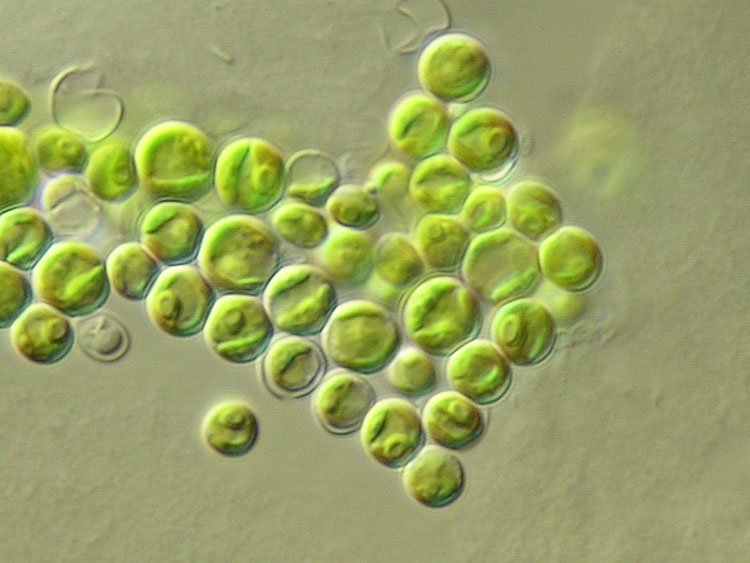
Let’s talk about a microalga that quietly does big things.
Auxenochlorella is a group of unicellular green microalgae in the family Chlorellaceae. Small cells, serious performance. They grow fast, use light efficiently, and can switch their metabolism depending on environmental conditions. Some species grow photoautotrophically, others can also use organic carbon sources. That flexibility makes the genus highly attractive for biotechnology.
Why does that matter? Because these algae convert CO₂ and nutrient rich waste streams into valuable biomass. They are studied for carbon capture, wastewater treatment, and sustainable biomass production. In the context of a circular bioeconomy, that combination of productivity and resource efficiency is hard to ignore.
Now to this month’s focus.
Auxenochlorella pyrenoidosa is widely recognized for its robust growth and high protein content, which makes it relevant for food, feed, and nutraceutical applications. It is also explored for pigment production and as a functional ingredient in health related products. Its ability to grow at scale and to utilize diverse cultivation systems underlines its economic relevance and growing importance in sustainable production strategies.
For the isolate RLXCh3, we did not cut corners.
Structural gene annotation combined homology based prediction, transcript evidence, and ab initio modeling through the mendle®-analytics pipeline. In plain terms, we stacked multiple lines of evidence instead of relying on a single shortcut. The outcome speaks for itself: 11,226 predicted protein coding genes and 11,894 total gene models.
If you want the full picture, dive into the online annotation report. And if you are curious how quality really shows up in practice, open the JBrowse instance. There you will find a track with mapped BUSCO sequences, which gives you a direct visual comparison between a carefully curated genome annotation and a quick and dirty version. The difference is not subtle.
Small organism. Broad impact.
See the full annotation here: https://mendle.org/analytics/project/sGLSnR5e/results